
'Cockroach Party' protestors demand Indian elections chief resign
Thousands of "Cockroach Party" protesters in India have taken to the streets, calling for one of the country's chief electoral commissioner to be impeached.
People surrounding a police vehicle during the protest on Friday. ( Reuters: Adnan Abidi )
Hundreds of "Cockroach Party" protesters in India have taken to the streets, calling for the country's chief electoral commissioner to be impeached.
The move comes after a controversial voter roll revision which the protesters allege amounted to electoral manipulation.
The commission and the government have denied wrongdoing.
India's prime minister is facing renewed pressure as thousands led by the Cockroach Janta Party (CJP) and activist groups took to the streets demanding the resignation of the elections commission chief over a controversial voter roll revision.
The protests mark the latest escalation in a dispute that has put unprecedented scrutiny on India's Election Commission, long regarded as one of the country's most trusted institutions.
The Mumbai rally is intended to kick off a new period of demonstrations nationwide.
Separately, police prevented student and civil society groups from gathering Friday at Jantar Mantar, a designated protest site in New Delhi, to also demand the commissioner's resignation.
Police detained some opposition leaders heading to the site, which had been barricaded off.
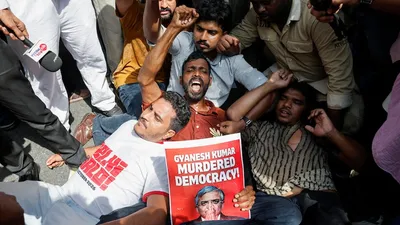
People detained by the police during a protest demanding the resignation of Gyanesh Kumar. ( Reuters: Adnan Abidi )
The protesters' allege the commission manipulated voter rolls in ways that favour Prime Minister Narendra Modi's Bharatiya Janata Party (BJP).
"We have been asking and demanding for a change but nothing of that is going to happen, if our only tool that is left to change anything in our society 'the right to vote' is taken away from us," Saurav Das, CJP's convenor, told Indian news agency ANI on Thursday.
"We will only end the protest after Gyanesh Kumar resigns."
The main opposition Congress party has said Mr Kumar should be criminally prosecuted for treason.
The commission and the government have denied the allegations.
Pressure on Election Commissioner Gyanesh Kumar intensified last month after the Indian Express newspaper reported the election chief's two deputies had formally raised concerns at least 14 times over the past 10 months over voter-list revisions, registration procedures and the commission's digital systems.
The Election Commission has said differing views are a normal part of internal deliberations and that all its actions were lawful.
Political analysts estimate that 130 million names have been struck off the voter list since the latest round of revisions began last year.
Nearly 650 million people voted in the last national election in 2024.
The commission says the exercise is intended to remove duplicate, deceased or ineligible voters and ensure the accuracy of electoral rolls.
Political scientists Rahul Verma told ABC's The World there was "no doubt" the majority of those deleted were deceased or moved away.
But he said people were "suffering" because of the amount of documentation needed to prove why they should remain registered.
A woman is detained during a protest demanding the resignation of India's Chief Election Commissioner. ( Reuters: Adnan Abidi )
Mr Verma said he has not seen this level of mass outrage among general voters since the controversial revision process started in 2025.
India began verification of its voter rolls of elections in the eastern state of Bihar. The review has now covered the majority of Indian states.
While voter roll revisions are routine, this round became controversial after large numbers of voters in states such as Bihar and West Bengal found their names missing from electoral rolls and were unable to cast ballots.
"While the chief commissioner and election commission may have its own explanation for why things were happening the way they have been happening, the trust in [the] election commission at this moment has taken a hit," Mr Verma said.
Activists shout slogans during a protest against Chief Election Commissioner Gyanesh Kumar.
Mr Verma said the only way for the chief commissioner to be removed is through parliamentary impeachment but it was unlikely to happen because the opposition does not have the numbers to force such a move.
But he did not rule it out because the CJP spearheaded mass protests earlier this year over unemployment and leaked examination papers triggered the resignation of India's education minister, one of Mr Modi's most significant political setbacks in recent years.
Headed by Abhijeet Dipke, the CJP is a youth movement that emerged earlier this year and has become an unexpected political force.
While education and employment was an "emotive" issue that cut across all young people, Mr Verma was skeptical the electoral roll revision would carry the same sway.
"Whether this movement or organisation has ability to mobilise again and again is at this moment difficult to say."